‘Volatility is opportunity’: why this manager loves shorting stocks

Angela Aldrich of Bayberry Capital Partners LP bet against Treasury Wine Estates at the top of the market and now she's preparing to make her next big call at this year's Sohn Hearts & Minds Conference.

Joshua Peach

‘Volatility is opportunity’: why this manager loves shorting stocks

September 18, 2023
Angela Aldrich of Bayberry Capital Partners LP bet against Treasury Wine Estates at the top of the market and now she's preparing to make her next big call at this year's Sohn Hearts & Minds Conference.
Read Transcript

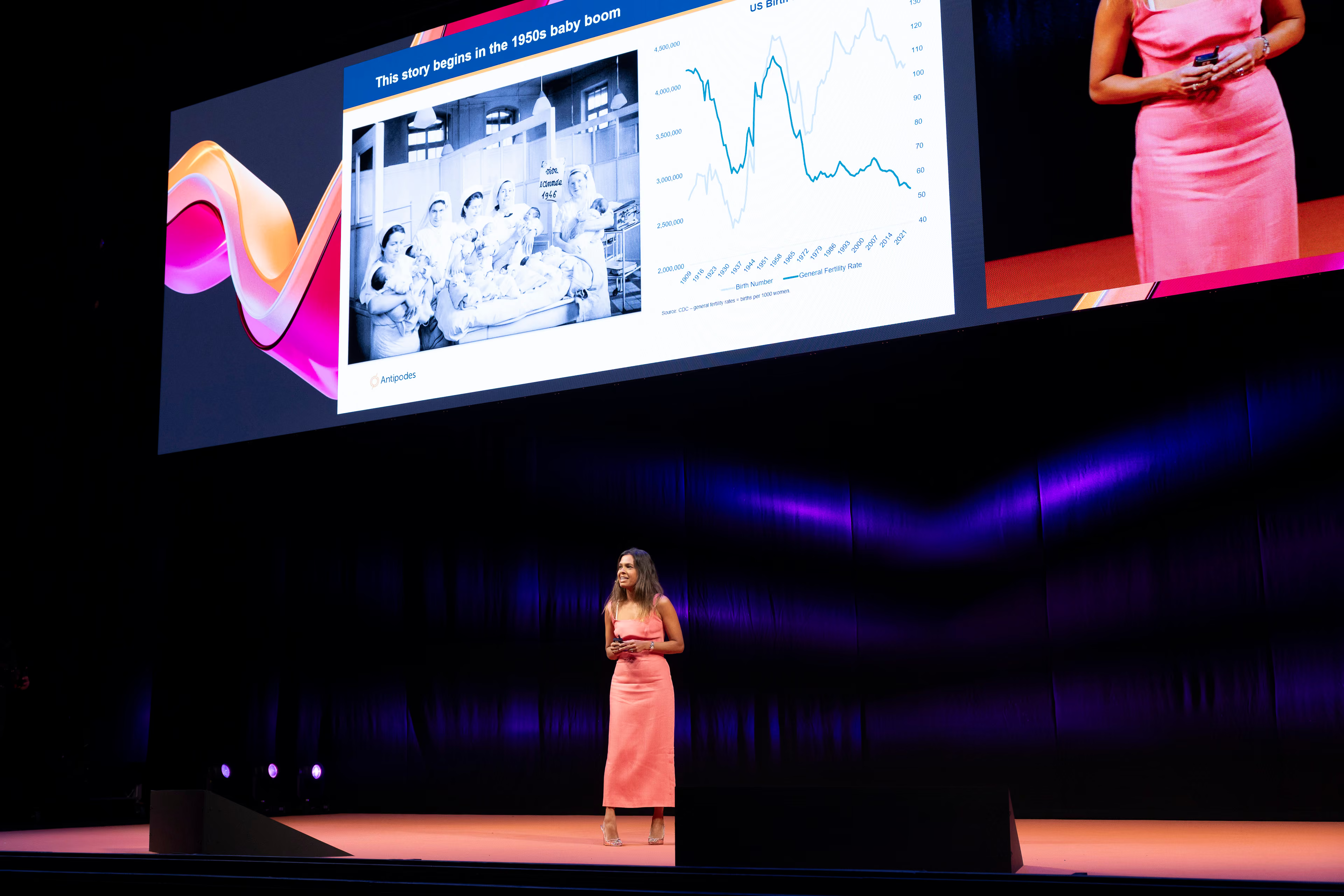
Four years ago, Angela Aldrich stood on a stage in New York and told the world her newly minted hedge fund Bayberry Capital Partners was shorting a winemaker listed on the other side of the world, Treasury Wine Estates.

In Australia, investors were shocked. The company, Australia’s largest wine producer, had been on a three-year tear, jumping more than 300 per cent, and was showing little sign of slowing down.

Twelve months after Aldrich stepped off that stage at the Sohn Conference in Manhattan, Treasury Wines’ shares had tumbled 45 per cent.

“Our view wasn’t that TWE was a bad company or that they were doing something nefarious. It had been such a good stock for such a long period, but it started to look like cracks were showing,” Aldrich tells The Australian Financial Review.

“It was so beloved, but you were seeing some things on the balance sheets that didn’t necessarily jibe with what the market was thinking or what had been happening over the past few years

That proved prescient after Treasury Wine Estate downgraded the earnings of its US business the following year, erasing more than $3 billion of market value. It would be the start of a difficult era for the company, worsened by harsh Chinese wine tariffs and the outbreak of COVID-19.

“At some point, everything that’s priced for perfection reaches a point where expectations get too far ahead of themselves,” Aldrich adds.

At the time of the hedge fund manager’s now infamous call on the wine producer, Bayberry Capital was barely a year old, having launched on April Fools’ Day in 2018.

Learning from the ‘tiger cub’

But Aldrich was hardly new to the fund business, having already earned the nickname “Tiger grandcub” after apprenticing under hedge fund legend and famed “Tiger cub” investor John Griffin while at Blue Ridge Capital.

It was from Griffin, whom she worked with for six years, that Aldrich developed her love of betting against a stock. She joined Blue Ridge after stints with Scout Capital and BDT Capital, and at Goldman Sachs as an investment banking analyst after obtaining her MBA from the Stanford Graduate School of Business.

“I definitely caught the short-selling virus from John,” Aldrich says. “There is no cure. I am now that crazy person who is completely attached to the short side.

“John deeply loved the short side, and he just found it incredibly interesting. And he was obviously very good at it. He believed he could make money for investors on both sides of the portfolio, and I just thought that was so interesting.”

Griffin was president at Julian Robertson’s Tiger Management before forming Blue Ridge in 1996. The firm produced annualised returns of 15.4 per cent, consistently beating the benchmark S&P 500 Index across its two decades in operation.

It closed in 2017 and Aldrich launched Bayberry Capital a year later. While the thought of starting a hedge fund in the lead-up to a once-in-a-century pandemic may produce anxiety in some, Aldrich saw it as a stress test for her new venture.

“The past few years have been an entire lifetime of economic cycles. Seeing that type of disruption first-hand when you are managing your own portfolio was a totally different experience,” she says.

“I’m grateful that we got to see all of those things, and an ability to understand what happens to our portfolio in different economic situations.”

It was in that storm of volatility that Aldrich’s mentorship under Griffin really came to the fore.

“The most important lesson that I took from him, especially given what the last four years has been, is his true ability to watch volatility unemotionally,” Aldrich says.

“We need irrational moves in our shorts to get as much juice out of every position as possible. And so it’s been really great for us in this period, no matter which way the market has been moving.”

That doesn’t mean that it’s been painless, however.

One of the hedge fund’s first substantial long positions was Nasdaq-listed Willscot Mobile Mini Holdings, which dived more than 60 per cent from peak to trough during the early months of the pandemic.

“That was a huge use of capital and this wasn’t too long after we launched the fund,” she laments.

But while everything was selling off, the fund, which typically holds around 15 longs and 40 shorts, was buying up companies on the cheap, including online car auction company Copart.

“[It] had been on my fantasy list since I was a junior analyst and had [been] sold off like it was a travel business. Despite that, they actually ended up over-earning during the COVID period”, she says.

Meanwhile, on the other side of the portfolio, Aldrich leant into the short side of the business as the market recovered.

“The subsequent rebound was so violent that we got the opportunity to play existing shorts again, shorts that we’d already covered; we got a second and a third chance.”

More recently, Bayberry made what many would consider a high-stakes bet on UK-listed Burford Capital, a legal finance outfit that had plummeted when a pending court case in Argentina worried the market.

“You’re seeing a market that is very quick to pull the sell trigger,” Aldrich says. “They had this huge outstanding piece of litigation related to about 50 per cent of their stated book value when we started looking at the stock – people thought we were insane.

“You just needed this overhang to go away and people would start buying the stock again. The cherry on top was we thought that overhang was going to go in their favour, and that finally started happening in 2023.”

After winning the case, Burford Capital’s stock recovered rapidly and is now up more than 80 per cent year to date, making it the hedge fund’s best contributor so far this year.

Rooting for the underdogs

The Burford case mimics a lot of the companies that Bayberry picks up. Aldrich, who spends much of her free time volunteering at dog rescue charities, appears to have a soft spot for underdogs in her business life as well.

“We like the weird businesses where there’s no sort of pure-play competitor peer that you can look at,” she said.

Four years after Aldrich shorted Treasury Wine Estates, the stock is still down 25 per cent from the $16-per-share price tag in 2019. Meanwhile, Aldrich’s love of shorts has only grown.

“The reason the short side is so interesting to me personally is when you have high conviction that you’re seeing the cracks in a short today, it tends to be quicker for that information to reach the broader investment community and result in a share price decline,” she says. “I think there is a bad habit going around of viewing volatility as risk. There’s risk in everything. Volatility is the opportunity.”

Angela Aldrich will join 10 other portfolio managers to speak at Sohn Hearts & Minds at the Sydney Opera House on November 17. All profits will support Australian medical research organisations.

The Australian Financial Review is a media partner for the event.


This article was originally posted by The Australian Financial Review here.

Licensed by Copyright Agency. You must not copy this work without permission.

Disclaimer: This material has been prepared by Australian Financial Review, published on 18 September 2023. HM1 is not responsible for the content of linked websites or content prepared by third party. The inclusion of these links and third-party content does not in any way imply any form of endorsement by HM1 of the products or services provided by persons or organisations who are responsible for the linked websites and third-party content. This information is for general information only and does not consider the objectives, financial situation or needs of any person. Before making an investment decision, you should read the relevant disclosure document (if appropriate) and seek professional advice to determine whether the investment and information is suitable for you.
Four years ago, Angela Aldrich stood on a stage in New York and told the world her newly minted hedge fund Bayberry Capital Partners was shorting a winemaker listed on the other side of the world, Treasury Wine Estates.

In Australia, investors were shocked. The company, Australia’s largest wine producer, had been on a three-year tear, jumping more than 300 per cent, and was showing little sign of slowing down.

Twelve months after Aldrich stepped off that stage at the Sohn Conference in Manhattan, Treasury Wines’ shares had tumbled 45 per cent.

“Our view wasn’t that TWE was a bad company or that they were doing something nefarious. It had been such a good stock for such a long period, but it started to look like cracks were showing,” Aldrich tells The Australian Financial Review.

“It was so beloved, but you were seeing some things on the balance sheets that didn’t necessarily jibe with what the market was thinking or what had been happening over the past few years

That proved prescient after Treasury Wine Estate downgraded the earnings of its US business the following year, erasing more than $3 billion of market value. It would be the start of a difficult era for the company, worsened by harsh Chinese wine tariffs and the outbreak of COVID-19.

“At some point, everything that’s priced for perfection reaches a point where expectations get too far ahead of themselves,” Aldrich adds.

At the time of the hedge fund manager’s now infamous call on the wine producer, Bayberry Capital was barely a year old, having launched on April Fools’ Day in 2018.

Learning from the ‘tiger cub’

But Aldrich was hardly new to the fund business, having already earned the nickname “Tiger grandcub” after apprenticing under hedge fund legend and famed “Tiger cub” investor John Griffin while at Blue Ridge Capital.

It was from Griffin, whom she worked with for six years, that Aldrich developed her love of betting against a stock. She joined Blue Ridge after stints with Scout Capital and BDT Capital, and at Goldman Sachs as an investment banking analyst after obtaining her MBA from the Stanford Graduate School of Business.

“I definitely caught the short-selling virus from John,” Aldrich says. “There is no cure. I am now that crazy person who is completely attached to the short side.

“John deeply loved the short side, and he just found it incredibly interesting. And he was obviously very good at it. He believed he could make money for investors on both sides of the portfolio, and I just thought that was so interesting.”

Griffin was president at Julian Robertson’s Tiger Management before forming Blue Ridge in 1996. The firm produced annualised returns of 15.4 per cent, consistently beating the benchmark S&P 500 Index across its two decades in operation.

It closed in 2017 and Aldrich launched Bayberry Capital a year later. While the thought of starting a hedge fund in the lead-up to a once-in-a-century pandemic may produce anxiety in some, Aldrich saw it as a stress test for her new venture.

“The past few years have been an entire lifetime of economic cycles. Seeing that type of disruption first-hand when you are managing your own portfolio was a totally different experience,” she says.

“I’m grateful that we got to see all of those things, and an ability to understand what happens to our portfolio in different economic situations.”

It was in that storm of volatility that Aldrich’s mentorship under Griffin really came to the fore.

“The most important lesson that I took from him, especially given what the last four years has been, is his true ability to watch volatility unemotionally,” Aldrich says.

“We need irrational moves in our shorts to get as much juice out of every position as possible. And so it’s been really great for us in this period, no matter which way the market has been moving.”

That doesn’t mean that it’s been painless, however.

One of the hedge fund’s first substantial long positions was Nasdaq-listed Willscot Mobile Mini Holdings, which dived more than 60 per cent from peak to trough during the early months of the pandemic.

“That was a huge use of capital and this wasn’t too long after we launched the fund,” she laments.

But while everything was selling off, the fund, which typically holds around 15 longs and 40 shorts, was buying up companies on the cheap, including online car auction company Copart.

“[It] had been on my fantasy list since I was a junior analyst and had [been] sold off like it was a travel business. Despite that, they actually ended up over-earning during the COVID period”, she says.

Meanwhile, on the other side of the portfolio, Aldrich leant into the short side of the business as the market recovered.

“The subsequent rebound was so violent that we got the opportunity to play existing shorts again, shorts that we’d already covered; we got a second and a third chance.”

More recently, Bayberry made what many would consider a high-stakes bet on UK-listed Burford Capital, a legal finance outfit that had plummeted when a pending court case in Argentina worried the market.

“You’re seeing a market that is very quick to pull the sell trigger,” Aldrich says. “They had this huge outstanding piece of litigation related to about 50 per cent of their stated book value when we started looking at the stock – people thought we were insane.

“You just needed this overhang to go away and people would start buying the stock again. The cherry on top was we thought that overhang was going to go in their favour, and that finally started happening in 2023.”

After winning the case, Burford Capital’s stock recovered rapidly and is now up more than 80 per cent year to date, making it the hedge fund’s best contributor so far this year.

Rooting for the underdogs

The Burford case mimics a lot of the companies that Bayberry picks up. Aldrich, who spends much of her free time volunteering at dog rescue charities, appears to have a soft spot for underdogs in her business life as well.

“We like the weird businesses where there’s no sort of pure-play competitor peer that you can look at,” she said.

Four years after Aldrich shorted Treasury Wine Estates, the stock is still down 25 per cent from the $16-per-share price tag in 2019. Meanwhile, Aldrich’s love of shorts has only grown.

“The reason the short side is so interesting to me personally is when you have high conviction that you’re seeing the cracks in a short today, it tends to be quicker for that information to reach the broader investment community and result in a share price decline,” she says. “I think there is a bad habit going around of viewing volatility as risk. There’s risk in everything. Volatility is the opportunity.”

Angela Aldrich will join 10 other portfolio managers to speak at Sohn Hearts & Minds at the Sydney Opera House on November 17. All profits will support Australian medical research organisations.

The Australian Financial Review is a media partner for the event.


This article was originally posted by The Australian Financial Review here.

Licensed by Copyright Agency. You must not copy this work without permission.

Disclaimer: This material has been prepared by Australian Financial Review, published on 18 September 2023. HM1 is not responsible for the content of linked websites or content prepared by third party. The inclusion of these links and third-party content does not in any way imply any form of endorsement by HM1 of the products or services provided by persons or organisations who are responsible for the linked websites and third-party content. This information is for general information only and does not consider the objectives, financial situation or needs of any person. Before making an investment decision, you should read the relevant disclosure document (if appropriate) and seek professional advice to determine whether the investment and information is suitable for you.
Disclaimer: This material has been prepared by Australian Financial Review, published on Sep 18, 2023. HM1 is not responsible for the content of linked websites or content prepared by third party. The inclusion of these links and third-party content does not in any way imply any form of endorsement by HM1 of the products or services provided by persons or organisations who are responsible for the linked websites and third-party content. This information is for general information only and does not consider the objectives, financial situation or needs of any person. Before making an investment decision, you should read the relevant disclosure document (if appropriate) and seek professional advice to determine whether the investment and information is suitable for you.

facebook
linkedin
All
Thank you! Your submission has been received!
Oops! Something went wrong while submitting the form.
November 3, 2025

How to beat the market without owning Nvidia shares

Vihari Ross' global fund returned more than 20 per cent in the year to September 30 versus about 10 per cent for the benchmark without owning Nvidia, Meta, Tesla, Apple or Broadcom.

Read More
November 12, 2025

Square Peg's Ben Hensman names top picks in a hot tech sector

“We’re really looking for people who have that strong growth arc. Even though they’ve reached material scale, they’re still changing and moulding their company to move really fast, and they’re curious.”

Read More
Picture: Katje FordPicture: Katje FordPicture: Katje FordPicture: Katje Ford
November 14, 2025

'Here to pitch the parent company': Jim Chalmers' Sohn pick

The federal treasurer got into the spirit of the Sohn Hearts & Minds event with a big-picture investment tip – and a dig at our nation’s fundies.

Read More
November 14, 2025

Forget Trump volatility says top investor and focus on China threat to Australia

Australian investors should be more worried about China than sweating on Federal Reserve independence and other market obsessions to do with Donald Trump, says billionaire conservative Baron Michael Hintze.

Read More
Picture: Katje FordPicture: Katje FordPicture: Katje FordPicture: Katje Ford
November 14, 2025

Activism without proxy fights is like ‘Catholicism without hell’: Loeb

An older, wiser Dan Loeb reckons his activist approach has changed, but the Wall Street icon will never put away the big stick.

Read More
Picture: Katje FordPicture: Katje FordPicture: Katje FordPicture: Katje Ford
November 14, 2025

Net zero move good, but Libs need ‘north star’: Lord Hintze

Michael Hintze, one of Australia’s richest international ­billionaires and donor to ­conservative parties, says the Liberals are lacking a “north star” but dumping net zero was a smart move.

Read More
Picture: Katje FordPicture: Katje FordPicture: Katje FordPicture: Katje Ford
November 14, 2025

Third Point’s Loeb leads bullish investors despite stock slump

Major investors say the global economy is strong enough to withstand a bubble in artificial intelligence and turmoil in private credit markets despite a sharp fall on Wall Street and the ASX over the past week.

Read More
November 14, 2025

The 9 hottest stock tips from this year’s Sohn fund managers

Defying markets gloom, top investment chiefs pitched their best global ideas, from an “OG in AI” to a retirement giant.

Read More
Picture: Katje FordPicture: Katje FordPicture: Katje FordPicture: Katje Ford
November 14, 2025

10 top stock picks from Sohn Hearts & Minds conference 2025

Global fund managers gathered at the 2025 Sohn Hearts & Minds conference to pitch their best stock ideas. Here are all 10 tips in the order they were presented.

Read More
Photo: Kajie FordPhoto: Kajie FordPhoto: Kajie FordPhoto: Kajie Ford
November 18, 2025

Anthony Scaramucci says everyone in Trump's orbit hates him

“The Mooch”, as he’s affectionately known, is a man in high demand. He’s flown into Sydney to headline the Sohn Hearts & Minds conference at the Opera House, an investment community jamboree that raises money for charity. He landed in London the night before, and will leave Sydney the next day for the brutal 24-hour return to New York.

Read More
November 14, 2025

Queenstown to host 2026 Sohn Hearts & Minds Conference

We're thrilled to announce Queenstown, New Zealand, as the destination for the 2026 Investment Leaders Conference, to be held on Friday 6 November.

Read More
November 23, 2025

Nvidia's wild swings and 11 Sohn Hearts & Minds stock picks reviewed

Equity Mates reviewed the high conviction stock picks presented at the 2025 Sohn Hearts & Minds Conference.

Read More
December 19, 2024

Rikki Bannan – Don’t get caught up in momentum

Conference Fund Manager Rikki Bannan, Executive Director at IFM Investors, joins Equity Mates to discuss her standout 2023 stock pick, Telix, and explore what opportunities lie ahead.

Read More
Nick Moakes of the Wellcome Trust told the Sohn Hearts & Minds conference that some investors were too optimistic about a reduction in rates. Picture: Ben SearcyNick Moakes of the Wellcome Trust told the Sohn Hearts & Minds conference that some investors were too optimistic about a reduction in rates. Picture: Ben SearcyNick Moakes of the Wellcome Trust told the Sohn Hearts & Minds conference that some investors were too optimistic about a reduction in rates. Picture: Ben SearcyNick Moakes of the Wellcome Trust told the Sohn Hearts & Minds conference that some investors were too optimistic about a reduction in rates. Picture: Ben Searcy
November 20, 2024

Trump unifies top investors in decade-long bullish outlook for US

Nick Moakes, CIO of the $72 billion Wellcome Trust, told the conference that too many investors were banking on a return to the ultra-low interest rates that prevailed over the past decade.

Read More
Wall Street legend Howard Marks told the Sohn event that US exceptionalism would endure. Picture: Ben SearcyWall Street legend Howard Marks told the Sohn event that US exceptionalism would endure. Picture: Ben SearcyWall Street legend Howard Marks told the Sohn event that US exceptionalism would endure. Picture: Ben SearcyWall Street legend Howard Marks told the Sohn event that US exceptionalism would endure. Picture: Ben Searcy
November 17, 2024

Is anyone brave or stupid enough to bet against America?

Stock pickers have been punished for betting against the US. The choice between consensus and contrarianism on American exceptionalism is now harder than ever.

Read More