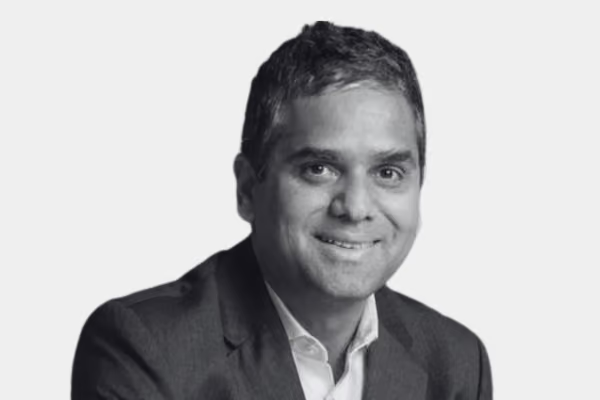
Scalar Gauge Fund founder Sumit Gautam cautious about over-hyped AI

Tech investor Sumit Gautam carefully avoids the word bubble when describing the investor frenzy surrounding the rise of artificial intelligence, but warns there are dangers of getting caught up in the hype.

Giuseppe Tauriello

Scalar Gauge Fund founder Sumit Gautam cautious about over-hyped AI

September 23, 2024
Tech investor Sumit Gautam carefully avoids the word bubble when describing the investor frenzy surrounding the rise of artificial intelligence, but warns there are dangers of getting caught up in the hype.
Read Transcript

Tech investor Sumit Gautam carefully avoids the word bubble when describing the investor frenzy surrounding the rise of artificial intelligence, but warns there are dangers of getting caught up in the hype drummed up by tech executives and venture capitalists around the emerging technology.

Tech companies leveraged to the AI boom have surged in the last couple of years, with investor groups ranging from the most sophisticated institutions to mum and dad investors pouring money in amid fears of missing out on the tech revolution.

AI poster child Nvidia’s share price has more than doubled this year alone, lifting the chip-maker's value to around $US2.8 trillion ($4.12 trillion), making it the third largest publicly traded company in the world after Apple and Microsoft.

Other tech giants, including Microsoft, Meta and Google owner Alphabet, are also riding the wave of investor demand, with double-digit share price growth since the start of the year.

While many analysts believe there is more growth to come, Gautam, who will be among the headline speakers at November’s Sohn Hearts & Minds investment conference in Adelaide, is more bearish about the ballooning valuations that have some fearing are a bubble waiting to burst.

“I would like to stay away from the word (bubble) but I would say that the pace of expectations and the amount of mind-share that AI has received in the last 18 months – it appears parabolic and capitalism does not like parabolic moves,” he says.

“I think AI is a theme, and everybody’s looking to invest in that theme. Our experience over the last decade-plus, both in the public market but before that private equity, is that investing in themes is usually not a good idea, because the way the fundamentals play out is very different than what you were investing in.

“Our experience always says that you want to invest in bottom-up evaluation of a company, and maybe the theme might help or might not help. We’re not trying to be predicting the future in any ways, but what we’re saying is that you’re better off taking things slow and letting it materialise with a relatively natural rate of growth, versus starting to have exponential growth, because exponential growth inevitably leads to crashes.”

After starting his career as a management consultant at McKinsey & Co, Gautam later worked at a tech start-up in Silicon Valley before moving into private equity at Bain and Audax Group, and later developed his tech investment specialisation while at $US1.3bn hedge fund Hirzel Capital.

In 2017 he launched Dallas-based Scalar Gauge Fund, a specialist platform that adopts a “private equity style of investing” to its holdings of predominantly US-listed software companies.

The fund has grown to around $US200m in assets under management, including a mix of passive investments and other companies where Gautam sees an opportunity to add value.

Described by some as an activist investor, Gautam prefers to focus on the “value creation” that comes with a more hands-on approach, including working closely with management to drive performance and at times pushing for board representation, as it recently has with billing software company Zuora.

“The way we think about this is as long as we are creating value, then the shareholders or the stakeholders will benefit from that value creation,” he says.

“We are focused on investing in undervalued, higher quality software companies in the public markets, but then we sometimes play a constructivist role in adding value to these companies, either just working with management, but also sometimes bringing in private equity to acquire these companies.

“So the claim to fame that we’ve had in the last seven years has been that 34 of our portfolio companies have been acquired, most of them by private equity.

“And 34 may not sound like a big number, but there’s only been about 60 public-to-private deals that have happened in this time frame in the space that we play in, in technology, so market share is more than 50 per cent.”

Indian-born Gautam studied engineering at the Indian Institute of Technology before moving to the US in the late 1990s for further studies at MIT.

He will not be drawn on his preferred candidate for the election in his adopted homeland, but says the US needs “more economic growth and we need to embrace more capitalism”.

While clearly a free marketeer, Gautam holds some concern over the rising power of the so-called Magnificent Seven tech giants.

Apple, Microsoft, Alphabet, Amazon, Nvidia, Meta and Tesla make up around a third of the S&P 500 index, and Scalar Gauge analysis suggests that based on growth rates over the past eight years the share they could reach two-thirds within the next ­decade. “Just by the nature of that power concentration, we don’t believe that society or the laws of economics will let that happen, because it’s just not a healthy place to be,” he said.

“If that’s not the case, which means that the historical returns are not going to be the same as future returns – if you believe that assertion, then you have to look elsewhere. The capitalistic way of thinking about it is that you’ll get new companies to challenge. There’s definitely a regulation aspect to it as well.

“In general, we like government to not be involved in the markets, because it’s generally inefficient. But we also can understand the reasons, that it has impact on society, impact on free speech – these companies have become a lot more influential.

“We have nothing against these companies. And they, of course, have done phenomenally well. But we don’t believe it’s healthy on a society, or on the information dissemination viewpoint, or from just the concentration of power in just one entity.”

Gautam will be among the headline speakers at this year’s Sohn event, which has raised $70m for medical research since its launch in 2016.

Attendees will hear stock tips and investment strategies from some of the world’s top fund managers, including Oaktree Capital co-founder Howard Marks, Sydney fund manager Alex Pollak, the founder of Loftus Peak, and Terra Capital founder and chief investment officer Jeremy Bond.

The Sohn Hearts & Minds conference will be held at Adelaide’s Festival Theatre on November 15.

This article was originally posted by The Australian here. 

Licensed by Copyright Agency. You must not copy this work without permission.

Disclaimer: This material has been prepared by The Australian, published on 23 September 2024. HM1 is not responsible for the content of linked websites or content prepared by third party. The inclusion of these links and third-party content does not in any way imply any form of endorsement by HM1 of the products or services provided by persons or organisations who are responsible for the linked websites and third-party content. This information is for general information only and does not consider the objectives, financial situation or needs of any person. Before making an investment decision, you should read the relevant disclosure document (if appropriate) and seek professional advice to determine whether the investment and information is suitable for you.

Tech investor Sumit Gautam carefully avoids the word bubble when describing the investor frenzy surrounding the rise of artificial intelligence, but warns there are dangers of getting caught up in the hype drummed up by tech executives and venture capitalists around the emerging technology.

Tech companies leveraged to the AI boom have surged in the last couple of years, with investor groups ranging from the most sophisticated institutions to mum and dad investors pouring money in amid fears of missing out on the tech revolution.

AI poster child Nvidia’s share price has more than doubled this year alone, lifting the chip-maker's value to around $US2.8 trillion ($4.12 trillion), making it the third largest publicly traded company in the world after Apple and Microsoft.

Other tech giants, including Microsoft, Meta and Google owner Alphabet, are also riding the wave of investor demand, with double-digit share price growth since the start of the year.

While many analysts believe there is more growth to come, Gautam, who will be among the headline speakers at November’s Sohn Hearts & Minds investment conference in Adelaide, is more bearish about the ballooning valuations that have some fearing are a bubble waiting to burst.

“I would like to stay away from the word (bubble) but I would say that the pace of expectations and the amount of mind-share that AI has received in the last 18 months – it appears parabolic and capitalism does not like parabolic moves,” he says.

“I think AI is a theme, and everybody’s looking to invest in that theme. Our experience over the last decade-plus, both in the public market but before that private equity, is that investing in themes is usually not a good idea, because the way the fundamentals play out is very different than what you were investing in.

“Our experience always says that you want to invest in bottom-up evaluation of a company, and maybe the theme might help or might not help. We’re not trying to be predicting the future in any ways, but what we’re saying is that you’re better off taking things slow and letting it materialise with a relatively natural rate of growth, versus starting to have exponential growth, because exponential growth inevitably leads to crashes.”

After starting his career as a management consultant at McKinsey & Co, Gautam later worked at a tech start-up in Silicon Valley before moving into private equity at Bain and Audax Group, and later developed his tech investment specialisation while at $US1.3bn hedge fund Hirzel Capital.

In 2017 he launched Dallas-based Scalar Gauge Fund, a specialist platform that adopts a “private equity style of investing” to its holdings of predominantly US-listed software companies.

The fund has grown to around $US200m in assets under management, including a mix of passive investments and other companies where Gautam sees an opportunity to add value.

Described by some as an activist investor, Gautam prefers to focus on the “value creation” that comes with a more hands-on approach, including working closely with management to drive performance and at times pushing for board representation, as it recently has with billing software company Zuora.

“The way we think about this is as long as we are creating value, then the shareholders or the stakeholders will benefit from that value creation,” he says.

“We are focused on investing in undervalued, higher quality software companies in the public markets, but then we sometimes play a constructivist role in adding value to these companies, either just working with management, but also sometimes bringing in private equity to acquire these companies.

“So the claim to fame that we’ve had in the last seven years has been that 34 of our portfolio companies have been acquired, most of them by private equity.

“And 34 may not sound like a big number, but there’s only been about 60 public-to-private deals that have happened in this time frame in the space that we play in, in technology, so market share is more than 50 per cent.”

Indian-born Gautam studied engineering at the Indian Institute of Technology before moving to the US in the late 1990s for further studies at MIT.

He will not be drawn on his preferred candidate for the election in his adopted homeland, but says the US needs “more economic growth and we need to embrace more capitalism”.

While clearly a free marketeer, Gautam holds some concern over the rising power of the so-called Magnificent Seven tech giants.

Apple, Microsoft, Alphabet, Amazon, Nvidia, Meta and Tesla make up around a third of the S&P 500 index, and Scalar Gauge analysis suggests that based on growth rates over the past eight years the share they could reach two-thirds within the next ­decade. “Just by the nature of that power concentration, we don’t believe that society or the laws of economics will let that happen, because it’s just not a healthy place to be,” he said.

“If that’s not the case, which means that the historical returns are not going to be the same as future returns – if you believe that assertion, then you have to look elsewhere. The capitalistic way of thinking about it is that you’ll get new companies to challenge. There’s definitely a regulation aspect to it as well.

“In general, we like government to not be involved in the markets, because it’s generally inefficient. But we also can understand the reasons, that it has impact on society, impact on free speech – these companies have become a lot more influential.

“We have nothing against these companies. And they, of course, have done phenomenally well. But we don’t believe it’s healthy on a society, or on the information dissemination viewpoint, or from just the concentration of power in just one entity.”

Gautam will be among the headline speakers at this year’s Sohn event, which has raised $70m for medical research since its launch in 2016.

Attendees will hear stock tips and investment strategies from some of the world’s top fund managers, including Oaktree Capital co-founder Howard Marks, Sydney fund manager Alex Pollak, the founder of Loftus Peak, and Terra Capital founder and chief investment officer Jeremy Bond.

The Sohn Hearts & Minds conference will be held at Adelaide’s Festival Theatre on November 15.

This article was originally posted by The Australian here. 

Licensed by Copyright Agency. You must not copy this work without permission.

Disclaimer: This material has been prepared by The Australian, published on 23 September 2024. HM1 is not responsible for the content of linked websites or content prepared by third party. The inclusion of these links and third-party content does not in any way imply any form of endorsement by HM1 of the products or services provided by persons or organisations who are responsible for the linked websites and third-party content. This information is for general information only and does not consider the objectives, financial situation or needs of any person. Before making an investment decision, you should read the relevant disclosure document (if appropriate) and seek professional advice to determine whether the investment and information is suitable for you.

Disclaimer: This material has been prepared by The Australian, published on September 23, 2024. HM1 is not responsible for the content of linked websites or content prepared by third party. The inclusion of these links and third-party content does not in any way imply any form of endorsement by HM1 of the products or services provided by persons or organisations who are responsible for the linked websites and third-party content. This information is for general information only and does not consider the objectives, financial situation or needs of any person. Before making an investment decision, you should read the relevant disclosure document (if appropriate) and seek professional advice to determine whether the investment and information is suitable for you.

facebook
linkedin
All
Thank you! Your submission has been received!
Oops! Something went wrong while submitting the form.
September 9, 2024

The Wellcome Trust’s Nick Moakes made a 100-year bet. It’s paying off

Chief Investment Officer, Nick Moakes raised almost $3 billion at ultra-low rates. Sometimes the long view can be the most profitable.

Read More
September 5, 2024

Honesty the only policy that matters, says Wellcome Trust’s Nicholas Moakes

The chief investment officer of the London-based $71bn Wellcome Trust, Nick Moakes, has a simple rule for the trust’s investment team: “Never invest with anyone who is or has been or should have been in prison.”

Read More
September 5, 2024

Why Howard Marks says you’re making a big mistake

Howard Marks says investors must ignore manic depressive markets and focus on the bigger picture. Rates will be higher for longer and that will bring pain – and opportunity.

Read More
July 21, 2024

Investors ‘comfortable’ about a Trump presidency, despite volatility

Economists and market experts say the outcome of the US presidential election has been largely priced in by investors as softening inflation helps to buoy sharemarkets both globally and locally.

Read More
January 24, 2024

How To Master The Art Of Winning The Room

Jonathan Pease, the creative director behind the Sohn Hearts & Minds Conference and author of the book, Winning the Room, recently sat down for a chat with Mark Bouris on Straight Talk.

Read More
November 17, 2023

‘I Know It Sounds Crazy’: Cathie Wood’s Next Big Idea

Speaking from Ark’s headquarters in Florida ahead of her appearance at the Sohn Hearts & Minds Conference on Friday, Wood says she believes disinflation is now just around the corner in the US.

Read More
IFM Investors small cap specialist Rikki Bannan addresses the Sohn Hearts & Minds Investment Leaders Conference at Sydney Opera House. Picture: Renee NowytargerIFM Investors small cap specialist Rikki Bannan addresses the Sohn Hearts & Minds Investment Leaders Conference at Sydney Opera House. Picture: Renee NowytargerIFM Investors small cap specialist Rikki Bannan addresses the Sohn Hearts & Minds Investment Leaders Conference at Sydney Opera House. Picture: Renee NowytargerIFM Investors small cap specialist Rikki Bannan addresses the Sohn Hearts & Minds Investment Leaders Conference at Sydney Opera House. Picture: Renee Nowytarger
November 17, 2023

Hot Stocks To Ride The Next Healthcare Trends

Healthcare stocks – from sleep apnoea giant ResMed, to cancer diagnostic biotech Telix Pharmaceuticals – were recommended at the Sohn Hearts & Minds Investment Leaders Conference on Friday.

Read More
November 17, 2023

How Daniel Loeb, The Real Bobby Axelrod, Made His Wall Street Billions

When Damian Lewis, the actor who plays the ruthless hedge fund boss in the drama series Billions was looking for inspiration, he sat down with Daniel Loeb.

Read More
November 17, 2023

Investors Sound Warning On Private Equity Timebomb

Institutional investors such as super and pension funds are investing in private equity at “exactly the wrong time,” a top hedge fund manager has warned, as sharply higher interest rates threaten a wave of bankruptcies.

Read More
November 17, 2023

The 12 Hottest Stock Tips From This Year’s Sohn Experts

It might be time to look beyond big names. That was the message from top fund managers, company founders and super funds at the Sohn Hearts & Minds.

Read More
Azora Capital founder Ravi Chopra. Picture: Renee NowytargerAzora Capital founder Ravi Chopra. Picture: Renee NowytargerAzora Capital founder Ravi Chopra. Picture: Renee NowytargerAzora Capital founder Ravi Chopra. Picture: Renee Nowytarger
November 17, 2023

Webster Financial ‘Avoided The Mistakes Of US Bank Failures’

The US financial sector is not without its problems but Ravi Chopra backs Webster Financial Corporation as his stock pick for the 2023 Sohn Hearts & Minds Investment Leaders Conference.

Read More
November 17, 2023

Why Stock Picker Cathie Wood Of ARK Can’t Stand Google

The world’s highest-profile tech investor, Cathie Wood, might be bruised but she is certainly bullish. Nor is she holding back.

Read More
Munro Partners partner and portfolio manager Kieran Moore at the Sohn Hearts & Minds conference in Sydney. Picture: Renee NowytargerMunro Partners partner and portfolio manager Kieran Moore at the Sohn Hearts & Minds conference in Sydney. Picture: Renee NowytargerMunro Partners partner and portfolio manager Kieran Moore at the Sohn Hearts & Minds conference in Sydney. Picture: Renee NowytargerMunro Partners partner and portfolio manager Kieran Moore at the Sohn Hearts & Minds conference in Sydney. Picture: Renee Nowytarger
November 17, 2023

Wise Share Price Could Rise 50pc By 2025, Says Munro Partners

Global growth fund manager Munro has about $4.3bn in funds under management across four global funds, and usually invests in companies that are poised to win from massive structural change.

Read More
November 16, 2023

Hedge Fund Veteran Talks Lowest Moment In Toscafund’s 23-Year Run

Most hedge fund managers brag about their wins and shy away from their losses – Martin Hughes is not most hedge fund managers.

Read More
November 16, 2023

The ‘Armageddon Scenario’ Worrying The Future Fund CIO

Mr Samild shared his thoughts on the bond market – which underpins the returns of other assets – ahead of his appearance at Friday’s Sohn Hearts & Minds charity conference at the Sydney Opera House.

Read More