Meet The Goldman Sachs Legend Shaking Up Venture Capital

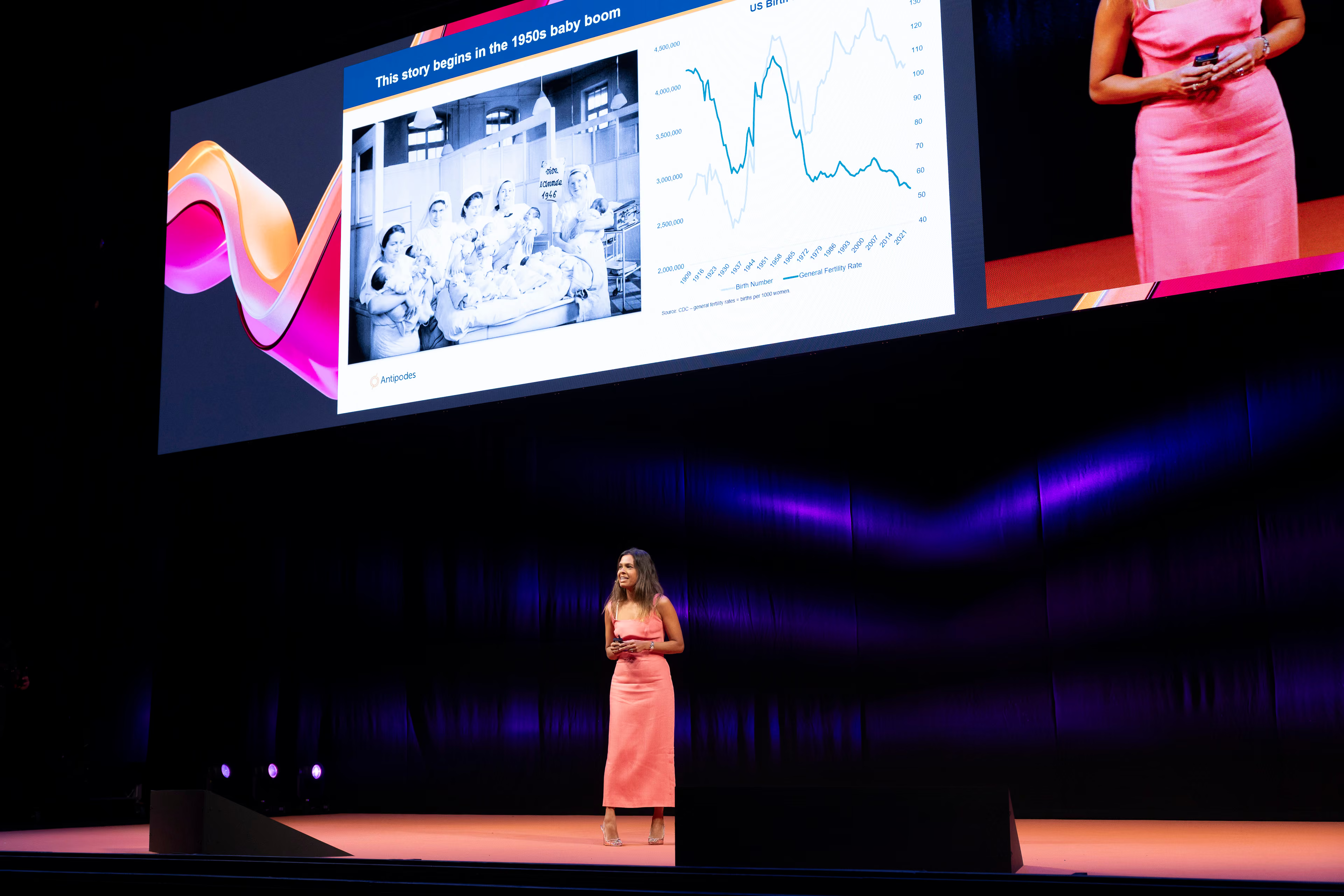
Sheila Patel says it was time for the venture capital sector to “grow up” and higher rates will help do that job. VC firms need to think differently about how they invest.

James Thomson

Meet The Goldman Sachs Legend Shaking Up Venture Capital

November 10, 2023
Sheila Patel says it was time for the venture capital sector to “grow up” and higher rates will help do that job. VC firms need to think differently about how they invest.
Read Transcript

Sheila Patel says it was time for the venture capital sector to “grow up” and higher rates will help do that job. VC firms need to think differently about how they invest.

Perhaps the most surprising thing about WeWork’s slide into bankruptcy is that it didn’t happen sooner.

But it’s fitting that a company with a business model so bizarre – this was a risky start-up built on sub-leasing expensive office space to other risky start-ups – collapsed in the same week Australian interest rates hit a 12-year-high.

There’s simply no way WeWork would have been valued at $US47 billion, as it was in early 2019, in today’s world of 5 per cent interest rates. But the fact it took so long to collapse reminds us that the excesses of the past decade are still seeping out of the system.


Australian superannuation funds who’ve increasingly increased their exposure to private assets would do well to remember that. But they should also heed the words of market veteran Sheila Patel, who will visit Australia next week for the Sohn Hearts & Minds conference at the Sydney Opera House next Friday.


She says this shakeout will take some time to play out. “You will see people really think about asset allocation in a different way because of the bar to which investments have to be held with the kind of yields we see in the market. And that doesn’t unwind itself in any quick way.”


Patel has had an extraordinary career. In 2021, she retired as the chair of Goldman Sachs $US2.7 trillion ($4.2 trillion) global asset management after 18 years with the firm. Now she is at the other end of capital markets as vice chair and general partner of B Capital, the venture capital firm set up by Facebook co-founder Eduardo Saverin. She is also co-chair at another VC firm, Antler.


The backdrop of rising yields has meant dramatic changes for start-up founders, who Patel says now must have both a good idea and a path to revenue and profitability. It’s harder to raise money, and valuations have fallen sharply. But that’s no bad thing, she argues.


“It forges a better founder to deal with adversity in this way. When you’re launching in this type of interest rate environment, you better be much more sure.”


But these changes are being felt across the entire sector, and venture capital firms also face a tougher fundraising environment as yields rise, valuations drop and institutional investors reassess their portfolios. Again, that’s no bad thing.


“It was time for the sector to grow up,” Patel says. VC firms are now “being held to a standard that everybody in other areas of private equity and other areas, other asset classes have long been familiar with, which is ‘what returns have you shown me lately?’”


But institutional investors will also have an eye on history, which shows that the very best VC returns are often made from investments made in tougher times.


Patel somehow found time to teach a class in derivatives at Columbia University when she was at Goldman Sachs, and she’s bringing a little of that thinking to the VC world. A derivatives trader, she explains, is trying to construct a portfolio that balances risk and reward.


This approach was arguably taken to its extreme by so-called crossover funds that sprayed cash around in late 2020 and 2021, essentially betting big winners would cover multiple losers. Patel’s goal is to swing the pendulum back to a thoughtful place.


“There hasn’t been much focus on that in the venture world, but it matters. It matters what sectors you choose, it matters what stages you invest in, and it certainly matters that you put together a fulsome enough portfolio.”

This article was originally posted by The Australian Financial Review here.

Licensed by Copyright Agency. You must not copy this work without permission.
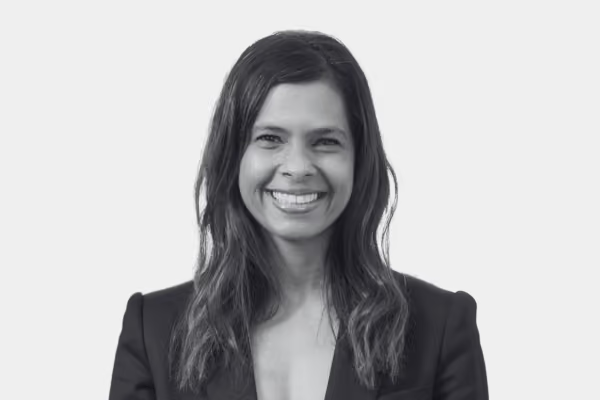
Sheila Patel says it was time for the venture capital sector to “grow up” and higher rates will help do that job. VC firms need to think differently about how they invest.

Perhaps the most surprising thing about WeWork’s slide into bankruptcy is that it didn’t happen sooner.

But it’s fitting that a company with a business model so bizarre – this was a risky start-up built on sub-leasing expensive office space to other risky start-ups – collapsed in the same week Australian interest rates hit a 12-year-high.

There’s simply no way WeWork would have been valued at $US47 billion, as it was in early 2019, in today’s world of 5 per cent interest rates. But the fact it took so long to collapse reminds us that the excesses of the past decade are still seeping out of the system.


Australian superannuation funds who’ve increasingly increased their exposure to private assets would do well to remember that. But they should also heed the words of market veteran Sheila Patel, who will visit Australia next week for the Sohn Hearts & Minds conference at the Sydney Opera House next Friday.


She says this shakeout will take some time to play out. “You will see people really think about asset allocation in a different way because of the bar to which investments have to be held with the kind of yields we see in the market. And that doesn’t unwind itself in any quick way.”


Patel has had an extraordinary career. In 2021, she retired as the chair of Goldman Sachs $US2.7 trillion ($4.2 trillion) global asset management after 18 years with the firm. Now she is at the other end of capital markets as vice chair and general partner of B Capital, the venture capital firm set up by Facebook co-founder Eduardo Saverin. She is also co-chair at another VC firm, Antler.


The backdrop of rising yields has meant dramatic changes for start-up founders, who Patel says now must have both a good idea and a path to revenue and profitability. It’s harder to raise money, and valuations have fallen sharply. But that’s no bad thing, she argues.


“It forges a better founder to deal with adversity in this way. When you’re launching in this type of interest rate environment, you better be much more sure.”


But these changes are being felt across the entire sector, and venture capital firms also face a tougher fundraising environment as yields rise, valuations drop and institutional investors reassess their portfolios. Again, that’s no bad thing.


“It was time for the sector to grow up,” Patel says. VC firms are now “being held to a standard that everybody in other areas of private equity and other areas, other asset classes have long been familiar with, which is ‘what returns have you shown me lately?’”


But institutional investors will also have an eye on history, which shows that the very best VC returns are often made from investments made in tougher times.


Patel somehow found time to teach a class in derivatives at Columbia University when she was at Goldman Sachs, and she’s bringing a little of that thinking to the VC world. A derivatives trader, she explains, is trying to construct a portfolio that balances risk and reward.


This approach was arguably taken to its extreme by so-called crossover funds that sprayed cash around in late 2020 and 2021, essentially betting big winners would cover multiple losers. Patel’s goal is to swing the pendulum back to a thoughtful place.


“There hasn’t been much focus on that in the venture world, but it matters. It matters what sectors you choose, it matters what stages you invest in, and it certainly matters that you put together a fulsome enough portfolio.”

This article was originally posted by The Australian Financial Review here.

Licensed by Copyright Agency. You must not copy this work without permission.

Disclaimer: This material has been prepared by Australian Financial Review, published on Nov 10, 2023. HM1 is not responsible for the content of linked websites or content prepared by third party. The inclusion of these links and third-party content does not in any way imply any form of endorsement by HM1 of the products or services provided by persons or organisations who are responsible for the linked websites and third-party content. This information is for general information only and does not consider the objectives, financial situation or needs of any person. Before making an investment decision, you should read the relevant disclosure document (if appropriate) and seek professional advice to determine whether the investment and information is suitable for you.

facebook
linkedin
All
Thank you! Your submission has been received!
Oops! Something went wrong while submitting the form.
November 3, 2025

How to beat the market without owning Nvidia shares

Vihari Ross' global fund returned more than 20 per cent in the year to September 30 versus about 10 per cent for the benchmark without owning Nvidia, Meta, Tesla, Apple or Broadcom.

Read More
November 12, 2025

Square Peg's Ben Hensman names top picks in a hot tech sector

“We’re really looking for people who have that strong growth arc. Even though they’ve reached material scale, they’re still changing and moulding their company to move really fast, and they’re curious.”

Read More
Picture: Katje FordPicture: Katje FordPicture: Katje FordPicture: Katje Ford
November 14, 2025

'Here to pitch the parent company': Jim Chalmers' Sohn pick

The federal treasurer got into the spirit of the Sohn Hearts & Minds event with a big-picture investment tip – and a dig at our nation’s fundies.

Read More
November 14, 2025

Forget Trump volatility says top investor and focus on China threat to Australia

Australian investors should be more worried about China than sweating on Federal Reserve independence and other market obsessions to do with Donald Trump, says billionaire conservative Baron Michael Hintze.

Read More
Picture: Katje FordPicture: Katje FordPicture: Katje FordPicture: Katje Ford
November 14, 2025

Activism without proxy fights is like ‘Catholicism without hell’: Loeb

An older, wiser Dan Loeb reckons his activist approach has changed, but the Wall Street icon will never put away the big stick.

Read More
Picture: Katje FordPicture: Katje FordPicture: Katje FordPicture: Katje Ford
November 14, 2025

Net zero move good, but Libs need ‘north star’: Lord Hintze

Michael Hintze, one of Australia’s richest international ­billionaires and donor to ­conservative parties, says the Liberals are lacking a “north star” but dumping net zero was a smart move.

Read More
Picture: Katje FordPicture: Katje FordPicture: Katje FordPicture: Katje Ford
November 14, 2025

Third Point’s Loeb leads bullish investors despite stock slump

Major investors say the global economy is strong enough to withstand a bubble in artificial intelligence and turmoil in private credit markets despite a sharp fall on Wall Street and the ASX over the past week.

Read More
November 14, 2025

The 9 hottest stock tips from this year’s Sohn fund managers

Defying markets gloom, top investment chiefs pitched their best global ideas, from an “OG in AI” to a retirement giant.

Read More
Picture: Katje FordPicture: Katje FordPicture: Katje FordPicture: Katje Ford
November 14, 2025

10 top stock picks from Sohn Hearts & Minds conference 2025

Global fund managers gathered at the 2025 Sohn Hearts & Minds conference to pitch their best stock ideas. Here are all 10 tips in the order they were presented.

Read More
Photo: Kajie FordPhoto: Kajie FordPhoto: Kajie FordPhoto: Kajie Ford
November 18, 2025

Anthony Scaramucci says everyone in Trump's orbit hates him

“The Mooch”, as he’s affectionately known, is a man in high demand. He’s flown into Sydney to headline the Sohn Hearts & Minds conference at the Opera House, an investment community jamboree that raises money for charity. He landed in London the night before, and will leave Sydney the next day for the brutal 24-hour return to New York.

Read More
November 14, 2025

Queenstown to host 2026 Sohn Hearts & Minds Conference

We're thrilled to announce Queenstown, New Zealand, as the destination for the 2026 Investment Leaders Conference, to be held on Friday 6 November.

Read More
November 23, 2025

Nvidia's wild swings and 11 Sohn Hearts & Minds stock picks reviewed

Equity Mates reviewed the high conviction stock picks presented at the 2025 Sohn Hearts & Minds Conference.

Read More
December 19, 2024

Rikki Bannan – Don’t get caught up in momentum

Conference Fund Manager Rikki Bannan, Executive Director at IFM Investors, joins Equity Mates to discuss her standout 2023 stock pick, Telix, and explore what opportunities lie ahead.

Read More
Nick Moakes of the Wellcome Trust told the Sohn Hearts & Minds conference that some investors were too optimistic about a reduction in rates. Picture: Ben SearcyNick Moakes of the Wellcome Trust told the Sohn Hearts & Minds conference that some investors were too optimistic about a reduction in rates. Picture: Ben SearcyNick Moakes of the Wellcome Trust told the Sohn Hearts & Minds conference that some investors were too optimistic about a reduction in rates. Picture: Ben SearcyNick Moakes of the Wellcome Trust told the Sohn Hearts & Minds conference that some investors were too optimistic about a reduction in rates. Picture: Ben Searcy
November 20, 2024

Trump unifies top investors in decade-long bullish outlook for US

Nick Moakes, CIO of the $72 billion Wellcome Trust, told the conference that too many investors were banking on a return to the ultra-low interest rates that prevailed over the past decade.

Read More
Wall Street legend Howard Marks told the Sohn event that US exceptionalism would endure. Picture: Ben SearcyWall Street legend Howard Marks told the Sohn event that US exceptionalism would endure. Picture: Ben SearcyWall Street legend Howard Marks told the Sohn event that US exceptionalism would endure. Picture: Ben SearcyWall Street legend Howard Marks told the Sohn event that US exceptionalism would endure. Picture: Ben Searcy
November 17, 2024

Is anyone brave or stupid enough to bet against America?

Stock pickers have been punished for betting against the US. The choice between consensus and contrarianism on American exceptionalism is now harder than ever.

Read More