Beneficiary Profile: Black Dog Institute

1 in 5 of us will experience symptoms of mental illness in any given year. In Australia that’s around 5 million people. And roughly 60% of these people won’t seek help. Learn what Black Dog is doing to create a mentally healthier world for everyone.

Beneficiary Profile: Black Dog Institute

September 8, 2020
1 in 5 of us will experience symptoms of mental illness in any given year. In Australia that’s around 5 million people. And roughly 60% of these people won’t seek help. Learn what Black Dog is doing to create a mentally healthier world for everyone.
Read Transcript

1 in 5 of us will experience symptoms of mental illness in any given year. In Australia that’s around 5 million people. And roughly 60% of these people won’t seek help.

Science. Compassion. Action. As the only medical research institute in Australia to investigate mental health across the lifespan, Black Dog Institute’s aim is to create a mentally healthier world for everyone.

Black Dog Institute (BDI) improve the lives of people touched by mental illness through translational research. Integrating research findings with education programs, digital tools and apps, clinical services, and public resources leads to the discovery of new solutions, fosters connections and creates real-world change.

BDI take research out of the ivory tower and put it into action in health, educational, digital and corporate settings. Partnering with Hearts and Minds Investments Limited has allowed BDI to continue to conduct innovative and ground-breaking research in suicide prevention, youth and workplace mental health.

With the worst bushfire summer, and more recently the COVID-19 pandemic, the past year has been challenging for everyone. Hearts and Minds Investments Limited has funded BDI’s efforts to assist at-risk groups in need of some extra mental health support.

In early 2020, with BDI’s strong track record in improving the mental health of first responders, they were called upon by governments, fire services and the wider community to provide support, resources and advice in response to the horrific bushfire season. Evidence from BDI’s research was drawn on by governments to inform some of their decisions, and BDI engaged with many key stakeholder groups to provide expertise and guidance.

BDI have also responded quickly to the mental health needs of frontline healthcare workers during the COVID-19 pandemic. With partners across Australia, BDI launched The Essential Health Network which provides information and self-help resources, as well as a personalised, free, confidential assessment and triage services through the BDI clinic. It is designed specifically for people working under pressure within hospital services.

Black Dog Institute’s capacity to rapidly respond to these challenges is a reflection of the dedication and expertise of BDI’s researchers, lived experience staff, educators, psychologists, psychiatrists and support staff. Partners like Hearts and Minds Investments Limited and Paradice Investment Management, who share BDI’s commitment to improving mental health in our communities, make BDI’s advancements for mental health possible.

As part of our impact video series, we spoke with Director and Chief Scientist of Black Dog Institute, Scientia Professor Helen Christensen AO, discussing the importance of medical research and their recent breakthroughs. You can watch the video below.
1 in 5 of us will experience symptoms of mental illness in any given year. In Australia that’s around 5 million people. And roughly 60% of these people won’t seek help.

Science. Compassion. Action. As the only medical research institute in Australia to investigate mental health across the lifespan, Black Dog Institute’s aim is to create a mentally healthier world for everyone.

Black Dog Institute (BDI) improve the lives of people touched by mental illness through translational research. Integrating research findings with education programs, digital tools and apps, clinical services, and public resources leads to the discovery of new solutions, fosters connections and creates real-world change.

BDI take research out of the ivory tower and put it into action in health, educational, digital and corporate settings. Partnering with Hearts and Minds Investments Limited has allowed BDI to continue to conduct innovative and ground-breaking research in suicide prevention, youth and workplace mental health.

With the worst bushfire summer, and more recently the COVID-19 pandemic, the past year has been challenging for everyone. Hearts and Minds Investments Limited has funded BDI’s efforts to assist at-risk groups in need of some extra mental health support.

In early 2020, with BDI’s strong track record in improving the mental health of first responders, they were called upon by governments, fire services and the wider community to provide support, resources and advice in response to the horrific bushfire season. Evidence from BDI’s research was drawn on by governments to inform some of their decisions, and BDI engaged with many key stakeholder groups to provide expertise and guidance.

BDI have also responded quickly to the mental health needs of frontline healthcare workers during the COVID-19 pandemic. With partners across Australia, BDI launched The Essential Health Network which provides information and self-help resources, as well as a personalised, free, confidential assessment and triage services through the BDI clinic. It is designed specifically for people working under pressure within hospital services.

Black Dog Institute’s capacity to rapidly respond to these challenges is a reflection of the dedication and expertise of BDI’s researchers, lived experience staff, educators, psychologists, psychiatrists and support staff. Partners like Hearts and Minds Investments Limited and Paradice Investment Management, who share BDI’s commitment to improving mental health in our communities, make BDI’s advancements for mental health possible.

As part of our impact video series, we spoke with Director and Chief Scientist of Black Dog Institute, Scientia Professor Helen Christensen AO, discussing the importance of medical research and their recent breakthroughs. You can watch the video below.

Disclaimer: This material has been prepared by Black Dog Institute, published on September 8, 2020. HM1 is not responsible for the content of linked websites or content prepared by third party. The inclusion of these links and third-party content does not in any way imply any form of endorsement by HM1 of the products or services provided by persons or organisations who are responsible for the linked websites and third-party content. This information is for general information only and does not consider the objectives, financial situation or needs of any person. Before making an investment decision, you should read the relevant disclosure document (if appropriate) and seek professional advice to determine whether the investment and information is suitable for you.

facebook
linkedin
All
Thank you! Your submission has been received!
Oops! Something went wrong while submitting the form.
July 1, 2026

Improving care for adults with motor neuron diseases

Building better care for adults living with Motor Neuron Disease and Spinal Muscular Atrophy.

Read More
July 1, 2026

Understanding fatigue in young people with Charcot-Marie-Tooth disease

Developing a tool to improve understanding, research and care.

Read More
Pictured left to right: Professor Gina Ravenscroft (Perkins), Jasmine Chew, Sam Payne (CEO and Founder, Pink Elephants Support Network), and Shelby Mullin (Perkins).Pictured left to right: Professor Gina Ravenscroft (Perkins), Jasmine Chew, Sam Payne (CEO and Founder, Pink Elephants Support Network), and Shelby Mullin (Perkins).Pictured left to right: Professor Gina Ravenscroft (Perkins), Jasmine Chew, Sam Payne (CEO and Founder, Pink Elephants Support Network), and Shelby Mullin (Perkins).Pictured left to right: Professor Gina Ravenscroft (Perkins), Jasmine Chew, Sam Payne (CEO and Founder, Pink Elephants Support Network), and Shelby Mullin (Perkins).
July 1, 2026

Giving families living with rare diseases the answers they need

Supporting research to improve the diagnosis of rare genetic neuromuscular diseases and build the foundations for future treatments.

Read More
Picture: Dr Laura Grice, Lead Researcher Picture: Dr Laura Grice, Lead Researcher Picture: Dr Laura Grice, Lead Researcher Picture: Dr Laura Grice, Lead Researcher
July 1, 2026

Understanding spinal cord injury recovery

The world's first molecular map of spinal cord injury across time and injury levels

Read More
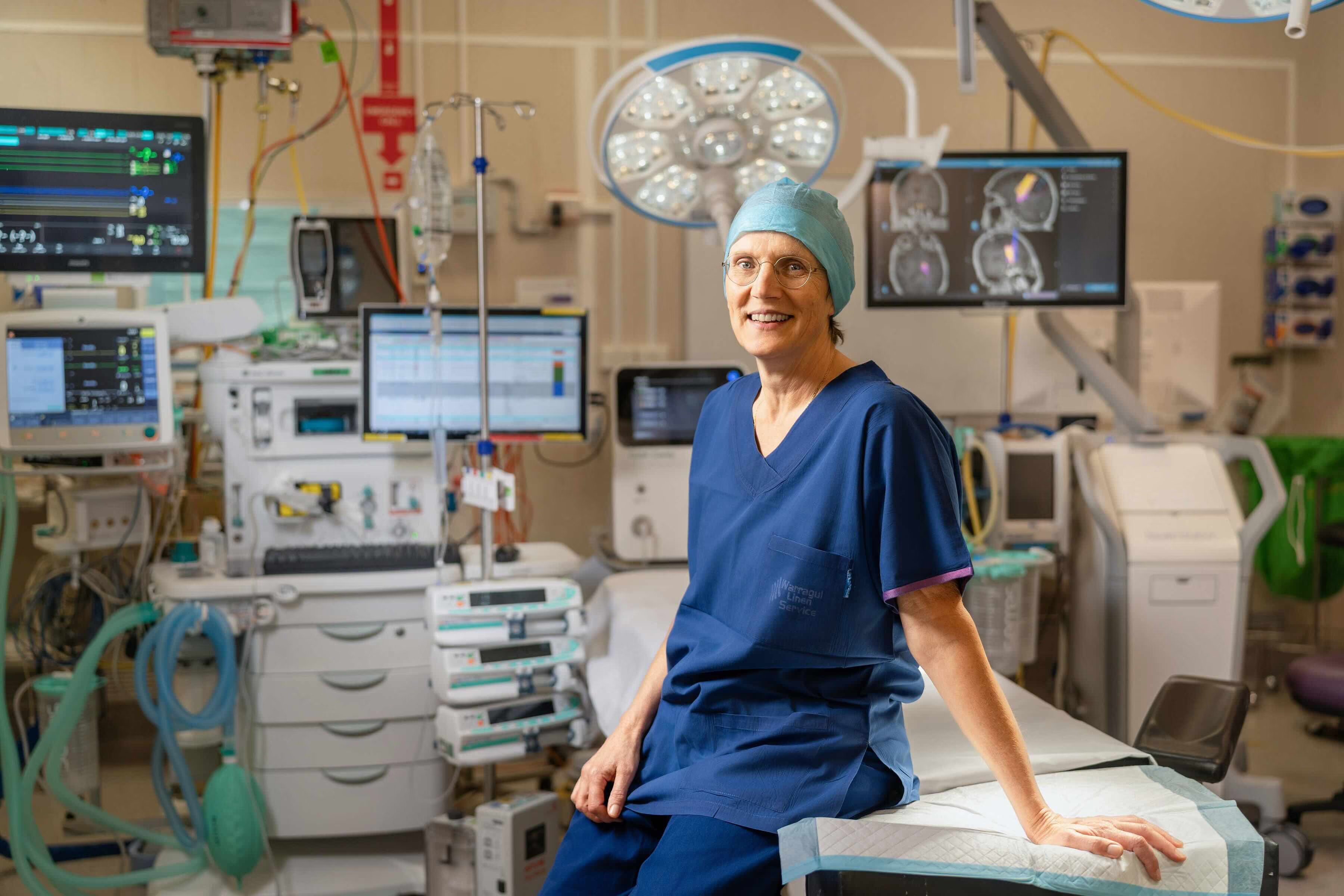
Picture: Professor Lindy Jeffree, Neurosurgeon and Chair, Brain Cancer Australia National Consortium Picture: Professor Lindy Jeffree, Neurosurgeon and Chair, Brain Cancer Australia National Consortium Picture: Professor Lindy Jeffree, Neurosurgeon and Chair, Brain Cancer Australia National Consortium Picture: Professor Lindy Jeffree, Neurosurgeon and Chair, Brain Cancer Australia National Consortium
July 1, 2026

Building the foundations for faster progress against brain cancer

Uniting researchers, clinicians and patients to accelerate research and improve patient care.

Read More
July 1, 2026

Accelerating CAR-T cell therapies for patients in need 

Bringing innovative cancer therapies closer to patients.

Read More
July 1, 2026

Supporting babies at high risk of cerebral palsy from the very beginning

Testing a family-centred early intervention program to improve outcomes for infants and support parents during the first critical months of life.

Read More
July 1, 2026

Making early cerebral palsy screening more accessible

Exploring new ways to identify babies at risk of cerebral palsy sooner and support better outcomes.

Read More
Picture: Professor Tracy Putoczki, Laboratory Head at WEHIPicture: Professor Tracy Putoczki, Laboratory Head at WEHIPicture: Professor Tracy Putoczki, Laboratory Head at WEHIPicture: Professor Tracy Putoczki, Laboratory Head at WEHI
July 1, 2026

Mapping the surface of pancreatic cancer cells

Identifying proteins on pancreatic cancer cells that could become new targets for developing future treatments.

Read More
Picture: Professor Jane Visvader and Professor Geoff Lindeman from the Breast Cancer Laboratory at WEHI Picture: Professor Jane Visvader and Professor Geoff Lindeman from the Breast Cancer Laboratory at WEHI Picture: Professor Jane Visvader and Professor Geoff Lindeman from the Breast Cancer Laboratory at WEHI Picture: Professor Jane Visvader and Professor Geoff Lindeman from the Breast Cancer Laboratory at WEHI
July 1, 2026

Understanding how breast cancer begins

Tracking the earliest changes in BRCA mutation carriers to help prevent cancer before it starts.

Read More
December 5, 2023

Prof Daniel MacArthur | 2023 Sohn Hearts & Minds Conference

At the 2023 Sohn Hearts & Minds Conference, we heard from Prof Daniel MacArthur, the Director of the Centre for Population Genomics.

Read More
December 5, 2023

Prof Michelle Simmons AO | Sohn Hearts & Minds Conference

At this year's Sohn Hearts & Minds Conference, we heard from Prof Michelle Simmons, the CEO and Founder of Silicon Quantum Computing.

Read More
December 5, 2023

Prof Misty Jenkins AO | 2023 Sohn Hearts & Minds Conference

At the 2023 Sohn Hearts & Minds Conference, we heard from Prof Misty Jenkins. Misty is a NHMRC fellow and laboratory head of the Immunology Division at the Walter and Eliza Hall Institute.

Read More
Daniel MacArthur speaking at the 2023 Sohn Hearts & Minds Conference in Sydney.Daniel MacArthur speaking at the 2023 Sohn Hearts & Minds Conference in Sydney.Daniel MacArthur speaking at the 2023 Sohn Hearts & Minds Conference in Sydney.Daniel MacArthur speaking at the 2023 Sohn Hearts & Minds Conference in Sydney.
November 15, 2023

Advancing Medicine Is In Daniel MacArthur’s DNA

When genomic scientist Daniel MacArthur had the opportunity to set up a new Centre for Population Genomics in Australia in 2019, he jumped at the chance to return home after 12 years living overseas.

Read More
November 10, 2023

Big thinkers in hunt for brain cancer cure

“Brain cancer is rare, but for people who do get it the prognosis is not good,” Assistant Professor Jenkins tells The Australian.

Read More